

Construction Entrepreneurship Insights: Real Lessons from Industry Leaders
Discover practical lessons from construction entrepreneurship leaders. Dive into masterclasses revealing insights on startup tips, building relationships, and innovative solutions in the built world.
By Foundamental University — Editor
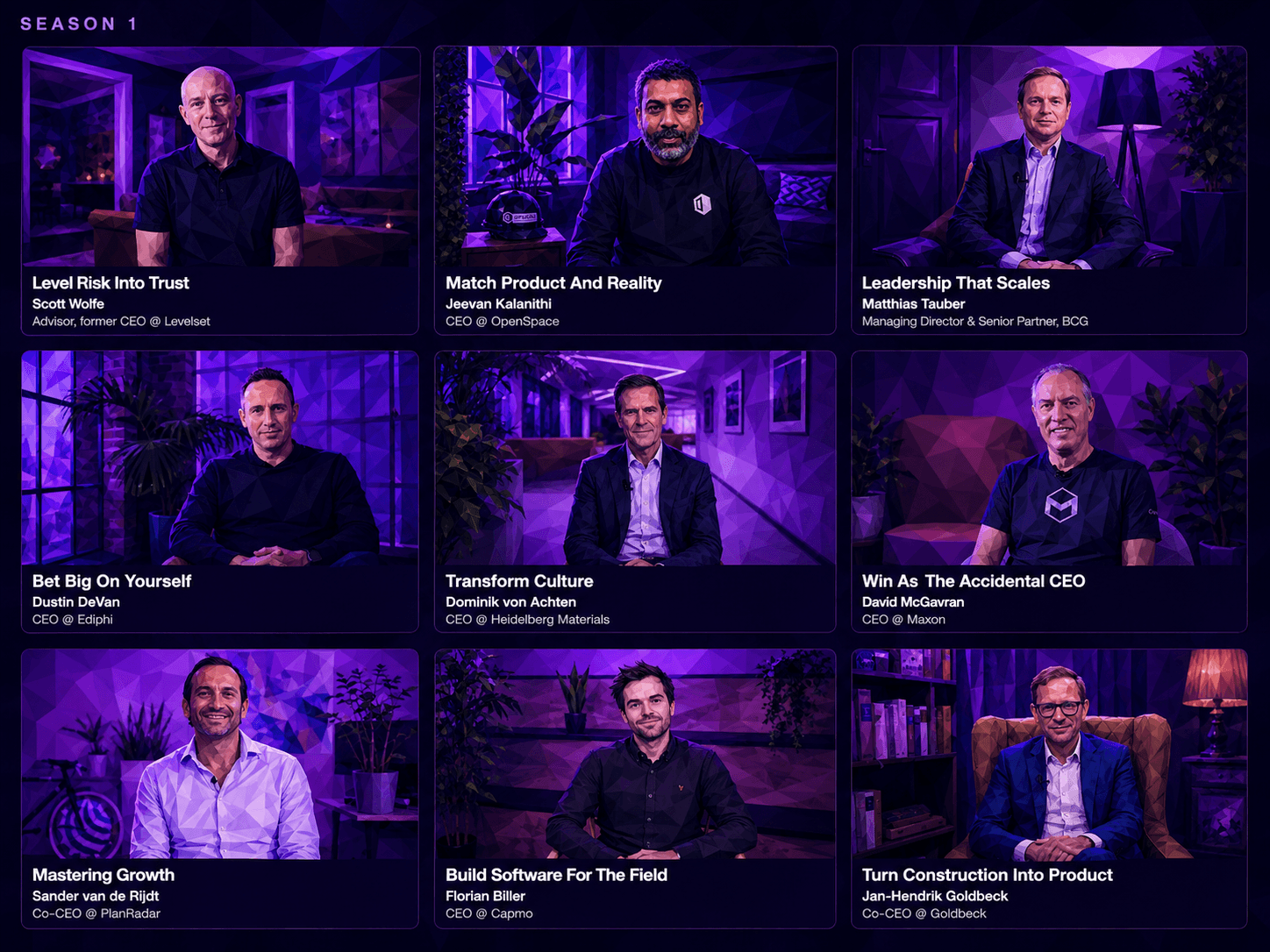
Construction Masterclass: Real Startup Tips from Founders
Most writing about entrepreneurship is generic. Start with a problem. Find product-market fit. Build a team. Scale. The advice is not wrong, but it is abstract in a way that makes it almost useless when you are standing on a job site at six in the morning trying to figure out why your subcontractor has not been paid, or sitting in a board meeting explaining why you are throwing out a backlog of 53 feature requests, or deciding whether to open source your entire codebase in an industry that has never heard of open source.
Construction entrepreneurship is its own discipline. The industry is fragmented, relationship-driven, slow to adopt technology, and structured around projects rather than products. The people who have built the most important companies in it did not do so by following generic startup playbooks. They did so by being steeped in real problems, making unconventional decisions, and learning lessons that rarely get shared outside of boardrooms and job site trailers.
Foundamental University was built to change that. Launched in April 2026 by Foundamental, the global venture capital firm focused on technology for the project economy, the platform features 13 in-depth construction masterclasses with founders, CEOs, and senior operators from across construction, infrastructure, and building materials. Each session runs about an hour and is built around the kind of practical, honest insight that usually stays locked inside founder circles.
This article draws on four of those masterclasses to surface the most important lessons about construction entrepreneurship from the people who have lived it. Think of it as a concise construction masterclass in field-tested startup tips and entrepreneurship construction.
All 13 construction masterclasses are freely accessible at university.foundamental.com.
Lesson 1: The Best Construction Companies Come from Being Steeped in the Problem
The most consistent theme across every Foundamental University masterclass is this: the founders who built the most durable companies in the built world did not search for a problem to solve. They were already living inside one.
Scott Wolfe, founder and former CEO of Levelset, describes his path into construction entrepreneurship as entirely accidental. His grandfather was a general contractor. His family pivoted into property restoration after Hurricane Katrina flooded New Orleans in 2005. He built software to manage the restoration company's processes, opened a construction law firm, and found himself immersed in the problem of construction payment almost by accident.
"Construction was a complete accident in my life," he says in his Foundamental masterclass. But the accident produced something that a deliberate search for startup ideas rarely does: genuine passion for a problem that most people would find obscure. "Building a company is really, really hard. Building a company that fails is hard. Building a company that succeeds is hard. You have to go through a lot of trial, a lot of toil, a lot of struggle, a lot of down moments. I don't have the ability to go through all of that for something I don't know deeply or don't care about deeply."
Dimitrie Stefanescu, founder and CEO of Speckle, found his founding insight in a similarly organic way. Working as an architect on a masterplan for Brussels Noord, he watched an economist build a sophisticated financial model that was supposed to inform architectural decisions and realized that nothing in his training had prepared him to bridge that gap. "When we design masterplans or buildings, the data is already part of that design. But it was very difficult to surface that back up in the language of an economist, or the language of the mayor, or the language of someone running a different feasibility study."
That frustration, accumulated over years of professional practice, became the intellectual foundation of Speckle. Not a pivot, not a pivot from a failing business model, but a direct response to a problem Dimitrie had lived with for years before he had the language or the tools to address it.
Jeevan Kalanithi's path to OpenSpace ran through 3D Robotics, a drone company where he served as president and watched the construction industry's appetite for visual information run up against the limitations of what drones could actually provide. When his co-founder Mike called with an idea about 360 cameras and apartments, Jeevan immediately redirected it toward construction. The insight was not new — it had been forming for years. "I felt the pain personally," he says. "And it seemed like something we could help with."
For anyone thinking about construction entrepreneurship, the practical implication is uncomfortable: there may be no shortcut to this kind of insight. You cannot manufacture genuine domain knowledge through research and interviews. You acquire it by working in the industry, feeling its frustrations, and building a point of view over time.
Lesson 2: Construction Startup Tips Start with Removing Work, Not Adding It
Construction is one of the few industries where the people you are selling to are never sitting at a desk. Superintendents, project managers, and site engineers are moving constantly, dealing with problems in real time, and deeply skeptical of anything that adds to their already overwhelming list of responsibilities.
This shapes everything about how successful construction technology companies are built.
Jeevan Kalanithi learned this directly from his experience with construction drones at 3D Robotics. Drones were genuinely useful: flying over a job site gave teams visibility they had never had before. But drones required someone to fly them, on a schedule, as a separate activity from everything else that person was responsible for. On a busy job site, that friction was fatal.
"Which exact person is going to go and fly the drone on Friday?" Jeevan recalls thinking. "These are all very busy people. They're trying to build a building, and flying a drone is yet another thing on the list."
The principle he drew from this experience became the founding constraint of OpenSpace: "If you're going to solve someone's problem, do it in a way that removes work, doesn't add it." The OpenSpace capture workflow, where a site walk with a 360 camera automatically generates a complete visual record of the job site, was built directly around this constraint. The technical difficulty of making it work that way was significant. But the alternative was a product that construction teams would not use regardless of how impressive the underlying technology was.
Dimitrie Stefanescu encountered the same constraint from a different angle. Open source software in AEC was initially perceived as free, which meant that any friction in the adoption process, any requirement to set up infrastructure or learn a new workflow, became a reason not to engage. The community-driven model Speckle used to grow, where enthusiasts could adopt the platform at whatever level of depth suited them and contribute back to the project, was a direct response to this reality.
For construction entrepreneurs, the practical startup tip here is one of the most counterintuitive in any industry: the simpler your product feels to use, the more technically complex it probably needs to be on the inside. The investment in that simplicity is not optional. It is the product.
Lesson 3: Go to Market by Helping First
Scott Wolfe's account of Levelset's go-to-market strategy is one of the most useful things in any of the Foundamental University masterclasses for anyone thinking about construction entrepreneurship.
Levelset grew primarily through content. Not content marketing in the sense of blog posts about the product, but genuinely useful information about construction payment law, lien rights, and the practical steps that contractors, subcontractors, and suppliers needed to take to protect themselves. The approach was so counterintuitive that Wolfe's own sales team pushed back on it.
"Our sales team was actually instrumental in crystallizing this, because what they noticed in their own process was that they were successful not when they were calling to sell something, but when they were calling to help."
He describes this as "help first," and argues that it applies across product, sales, and marketing simultaneously. "When companies and founders come to me for advice, I notice how much most of them want to sell their product. Their website is full of product content. Their blog is full of product announcements. Their press releases are about features. I get it — you need revenue. But there's a great book by Adam Grant called Give and Take. Marketing, product, and sales teams don't think of themselves as takers — but if you really dig in, they often aren't giving."
For construction specifically, this approach works because the industry has an extremely high appetite for practical help. Contractors and subcontractors are navigating sophisticated contracts, complex legal structures, and leverage dynamics that most of them were never trained to understand. "A construction contract is ridiculously more complex than the one you sign when you make a restaurant reservation. And not everyone goes into a construction project with the same understanding of their rights, their contracts, or their situation. That gap is enormous. It's where the opportunity is."
Jeevan Kalanithi's parallel insight is about customer proximity rather than content. In the earliest days of OpenSpace, he and his co-founders spent time as informal interns on job sites, sitting in on meetings, watching how people worked. The insight that shaped the company's core user experience came from a project manager telling him directly that nobody had time to spend an hour capturing job site photos. "If we had just been thinking about it in an office, we wouldn't have committed to building the technology the way it needed to be built."
The common thread: in construction entrepreneurship, going to market means starting from a position of genuine usefulness rather than from a position of wanting to sell.
Lesson 4: Hire for Culture, Address Problems Early
Matthias Tauber, Senior Partner at BCG and one of Europe's most experienced advisors to construction and infrastructure companies, uses his Foundamental University masterclass to lay out a leadership framework built on four lessons. Two of them are particularly relevant to construction entrepreneurship.
The first is hiring for culture before performance. When Tauber built BCG's building materials and construction team, he defined three non-negotiables: people who take care of themselves and each other; people with a genuinely high performance bar; and people who could connect authentically to a down-to-earth, real-world industry. These were not aspirational values. They were filters applied at every stage of hiring, promotion, and feedback.
"Hire for culture first, and only for performance second," he says. "Spend time on it. And think about hiring for culture, especially early on." His reasoning is practical: "The very early team norms you establish will shape the culture of the company for the long term."
Dimitrie Stefanescu learned a related lesson the hard way. In Speckle's early days, the team oversold the company in interviews, describing work-life balance as excellent when people were actually working around the clock. The result was hires who were not suited to what the company actually was. The fix was what Dimitrie calls anti-selling: a deliberate moment in every interview where the team describes plainly what is hard about working at Speckle.
"Depending on the role, we just say: Speckle actually sucks from the following points of view. And then people self-select." The candidates who stay are the ones who want exactly what the company actually is.
Tauber's second lesson concerns the speed of addressing difficult situations. "The biggest mistake you can make when it comes to difficult things is waiting too long. What might be small and easily correctable at the beginning becomes, if left unaddressed, the root cause of a major crisis later." His advice on feedback is precise: be timely, be specific, point to concrete situations, and make clear what could have been done differently.
Both Tauber and Dimitrie point to people decisions as the area where construction entrepreneurs most consistently act too slowly. "Almost everyone says retrospectively: I didn't do it fast enough," Tauber observes. "As a young founder, if there are significant issues with an early team member, address them early. It may be painful — but it's almost always better to do it early rather than too late."
Lesson 5: The Business Model Is Harder to Iterate Than the Product
Every experienced founder in the Foundamental University masterclasses makes some version of the same observation: product iteration is tractable. Business model iteration is where most companies get stuck.
Dimitrie Stefanescu is the most direct about this. "It's very easy to iterate on product. It's very easy to iterate on platform. The most difficult thing to iterate on — and where I feel most companies struggle, including us sometimes — is business model. This is where the most value is to be gained from iteration, rather than from pure product iteration."
For Speckle, navigating the transition from a free open source project to a commercial platform with a paying enterprise tier required years of deliberate community management, transparent communication, and careful expectation-setting. The open core model the company landed on, where the core platform remains open source and a proprietary enterprise layer sits on top, was not obvious from the beginning. It emerged through iteration and honest engagement with what the community and the market were actually willing to pay for.
Scott Wolfe's account of Levelset's three foundings illustrates the same point from a different angle. The company existed for five years as a side project before Wolfe committed to it fully. It then ran for three years on $500,000 in seed capital before raising a venture round. Each transition required not just a product decision but a fundamental rethinking of what the business was and how it would grow.
"One thing I look for when I think about starting something new is disempowerment," Wolfe says. "Where are people disempowered? What is disempowering them? What's not available to them?" That framing, which draws on Rich Barton's "power to the people" concept from Expedia, Zillow, and Glassdoor, is ultimately a business model question as much as a product question: what information asymmetry exists, who suffers from it, and how do you build a sustainable business around closing it?
Lesson 6: Managing Energy for the Long Run
Construction entrepreneurship is not a sprint. The companies that matter in this industry take years to build, require sustained relationships across long sales cycles, and operate in an environment where trust compounds slowly.
Matthias Tauber's framework for personal energy management is one of the most practically useful things in any of the Foundamental University masterclasses. "If you as a leader and founder don't radiate energy, the rest of your organization won't have energy either."
His distinction between physical and emotional energy is particularly relevant for construction founders, who often operate in demanding physical environments and navigate the emotional complexity of an industry built on relationships, disputes, and high-stakes financial decisions.
"Everyone knows physical health is important. And yet many people still don't prioritize it. My advice: don't overthink it — just get started. Set yourself goals you can actually achieve, step by step." For Tauber personally, the mountains provide both the physical outlet and the philosophical framework: "You need to manage your energy on the way up. There are ups and downs. You need to pace yourself. That's not a bad metaphor for leadership."
The emotional dimension comes back to the question of why. Tauber contrasts two leaders he observed during crisis periods: one who did all the right things technically but lacked genuine conviction, and one who carried the same work ethic but was driven by a deep emotional connection to the company and what it stood for. The second leader was more effective not because he worked harder but because his energy came from a place that sustained itself. "Whenever you face difficult situations, go back to your why."
Jeevan Kalanithi offers a related and equally honest perspective on the emotional reality of construction entrepreneurship. "I used to say in some board meetings: we're going to make this decision, and the worst thing that happens if I'm wrong is the company fails — and it's not that bad. No one's going to die." The point is not cavalier — it is a deliberate practice of keeping risk in perspective to avoid the paralysis that comes from taking every decision too seriously. "When we got too stressed out and too defensive, we started doing things that weren't that interesting."
Conclusion: Why Construction Entrepreneurship Is Different
The built world is one of the largest sectors of the global economy, one of the least digitized, and one of the most consequential for how people live and work. The founders and operators who are building the next generation of companies in construction, infrastructure, and building materials are doing something genuinely difficult: creating new categories in an industry that moves slowly, trusts relationships over products, and has decades of accumulated complexity in its contracts, its payment structures, and its technology stack.
The lessons that matter in this environment are not the generic ones. They are the ones that come from years of operating inside the industry, from real decisions made under real pressure, from companies that failed and companies that succeeded and the specific reasons why. They also function as practical startup tips for teams entering or scaling within the built world.
Foundamental University exists to make those lessons accessible. Season 1 features 13 in-depth masterclasses with founders, CEOs, and operators from across the built world, including the four conversations this article draws on. All sessions are freely available at university.foundamental.com. Season 2 is in development.
Related Articles: More from Foundamental University
- Scott Wolfe (Levelset) on construction payment, risk, and the "help first" go-to-market philosophy
- Jeevan Kalanithi (OpenSpace) on construction drones, progress tracking, and spatial AI
- Dimitrie Stefanescu (Speckle) on open source construction and rebuilding the data layer of AEC
- Matthias Tauber (BCG) on leadership that scales inside complex construction and infrastructure organizations
Frequently Asked Questions
Question: What makes construction entrepreneurship different, and how should that shape your idea stage?
Short answer: Construction is fragmented, relationship-driven, project-based, and slow to adopt tech—so generic startup playbooks rarely fit. The strongest ideas come from founders already living the industry’s pains, not from abstract “problem hunting.” Examples include Scott Wolfe (Levelset) stumbling into payment risk through family restoration work and a construction law firm, Dimitrie Stefanescu (Speckle) bridging architect–economist data gaps from practice, and Jeevan Kalanithi (OpenSpace) translating years of drone learnings into on-site visual capture. The takeaway: earn your insight by working in the field; there’s no shortcut to deep domain knowledge.
Question: How do you build construction tech that people on site will actually use?
Short answer: Remove work, don’t add it. Job-site teams are in motion and overloaded; any extra step kills adoption. OpenSpace built automated 360 capture around a normal site walk to eliminate “who flies the drone on Friday?” friction. Speckle lowered adoption barriers in open source by letting users engage at their own depth and contribute without heavy setup. If the product feels simple, it likely required heavy technical lifting—this inside-out complexity is the product.
Question: What does a “help first” go-to-market look like in construction?
Short answer: Lead with genuine usefulness before selling. Levelset grew by publishing practical guidance on payment law and lien rights—content that solved urgent problems, not product promos—because sales calls worked best when they started by helping. OpenSpace’s early team embedded on job sites, observing workflows and constraints firsthand; that proximity shaped a product people actually had time to use. In a sector full of contract and risk complexity, credibility and value come from solving real headaches upfront.
Question: How should founders hire and handle people issues early?
Short answer: Hire for culture first, performance second—especially early—because initial norms harden into long-term culture. Be radically clear about what’s hard (Speckle’s “anti-selling”), so candidates self-select into the reality, not the pitch. Address problems fast: give timely, specific feedback tied to concrete moments and what to do differently. Nearly every leader regrets moving too slowly on people decisions; early, decisive action prevents small issues from becoming crises.
Question: Why is business model iteration harder than product iteration, and what can you do about it?
Short answer: Products can iterate quickly; business models are entangled with customer expectations, community norms, and revenue mechanics. Speckle’s journey from free open source to an open-core model demanded years of transparent community management and careful expectation-setting. Levelset effectively “re-founded” multiple times—side project to focus, seed to venture—reframing how the business would grow. Approach business model change deliberately: test where users are disempowered, communicate clearly, and expect longer iteration cycles than product.