Win India
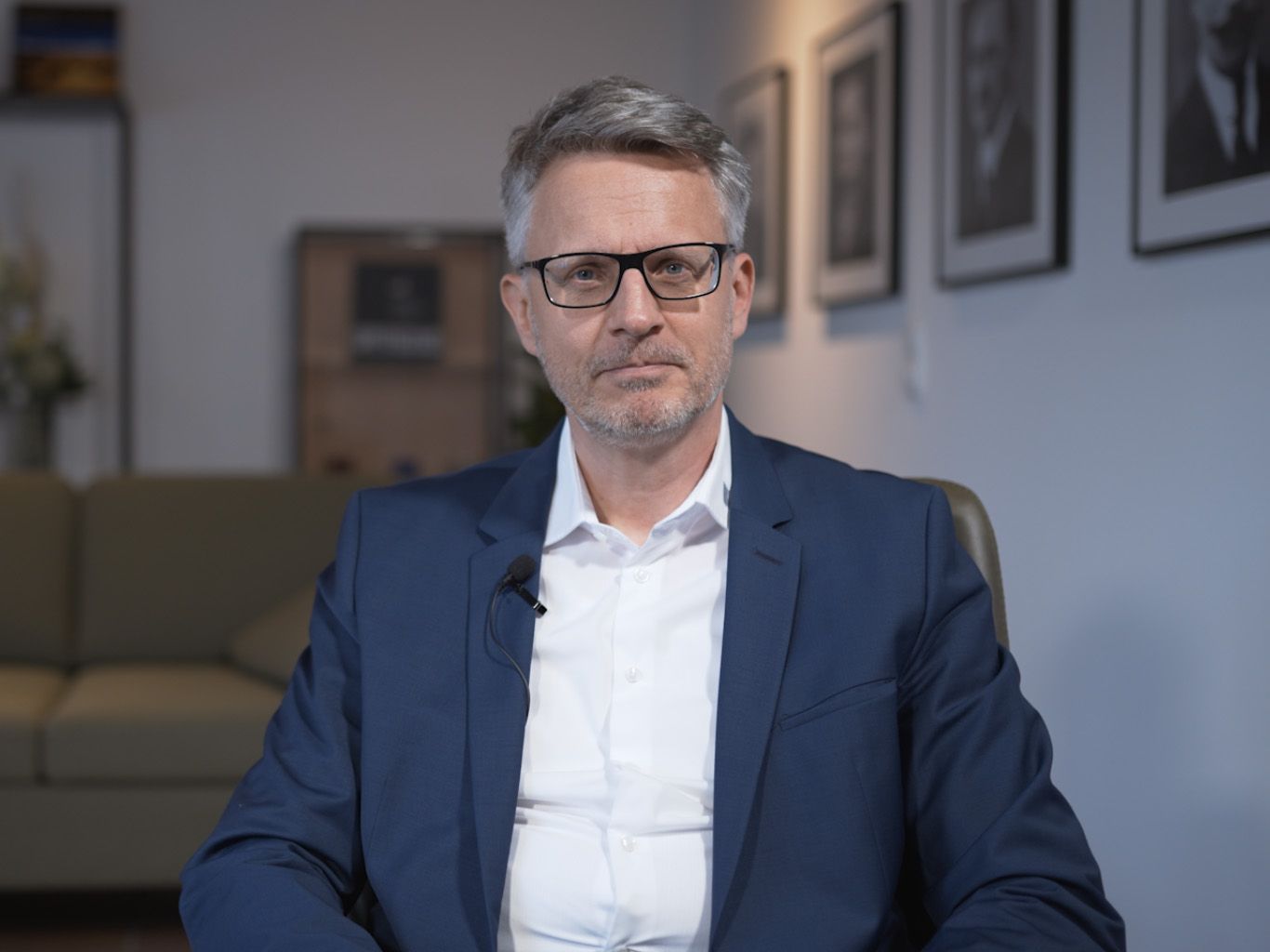
Andreas Hettich — Family Shareholder @ Hettich Group
About this masterclass
Andreas Hettich: Leading the Hettich Group for Generations
Andreas Hettich is a fourth-generation family shareholder of the Hettich Group, a global leader in interior solutions for furniture and kitchens, from hinges and runners to fittings and movement systems. With more than €1.4 billion in turnover, over 8,000 employees, and 18 production sites in 8 countries, Hettich is one of those companies most people don't know by name but encounter every day.
What This Masterclass Covers
This masterclass is unlike any founder story. It's a deep dive into what it means to lead and grow a family business across four generations, multiple continents, and more than 130 years, without losing discipline, culture, or identity along the way.
In this masterclass, Andreas Hettich walks through the history and logic of Hettich, his own path into the company, and what he's learned about scaling a global industrial business while keeping its soul intact:
- How he got into the business through numbers first, spotting mistakes and inconsistencies in large Excel sheets faster than most people around him
- Why international expansion should be staged: the classic path from importer to distributor to sales office to full subsidiary, learning each market step by step
- Why values don't scale automatically, and how Hettich uses in-house academies, Germany-based leadership training, and strong local management to carry technical know-how and heritage into every country organization
- How to find the right local leaders for international expansion: people who understand the local culture but can carry Hettich's standards and values into that market
- What patient company-building across generations looks like in practice, from product innovation and customer proximity to family ownership changes and long-term thinking
You Might Also Like
Turn Construction Into Product: Jan-Hendrik Goldbeck, Co-CEO @ Goldbeck
Make Decisions That Stick: David Rockhill,Global Head of Advisory @ Arcadis
Leadership That Scales: Matthias Tauber, Managing Director & Senior Partner @ BCG
Q&A
Question: Who is Andreas Hettich, and what is the Hettich Group?
Short answer: Andreas Hettich is a fourth-generation family shareholder of the Hettich Group, a global leader in interior solutions for furniture and kitchens. The company designs and manufactures components like hinges, runners, fittings, and movement systems, generating over €1.4 billion in turnover with more than 8,000 employees and 18 production sites across 8 countries—making it a brand many people use daily without realizing it.
Question: What makes this masterclass different from a typical founder story?
Short answer: Instead of a one-generation startup narrative, it examines how to lead and grow a family business over 130+ years and across continents without losing discipline, culture, or identity. Andreas shares the company’s history and logic, his own numbers-first entry into the business (spotting mistakes and inconsistencies in large Excel sheets), and concrete lessons on scaling an industrial company while keeping its “soul” intact.
Question: How does Hettich approach international expansion?
Short answer: Hettich advocates a staged path—progressing from importer to distributor to sales office to full subsidiary—so the organization can learn each market step by step. This reduces the risk of overreach and helps tailor operations to local realities before committing fully.
Question: How does Hettich ensure its values and know-how scale globally?
Short answer: Because values don’t scale automatically, Hettich invests in in-house academies, Germany-based leadership training, and strong local management. These mechanisms transfer technical expertise and company heritage into each country organization while maintaining consistent standards.
Question: What does “patient company-building across generations” look like in practice?
Short answer: It balances steady product innovation and close customer proximity with thoughtful family ownership transitions and long-term decision-making. The emphasis is on sustainable growth over decades—expanding internationally, developing leaders, and evolving the portfolio—while preserving the culture and identity that define Hettich.
Transcript
Introduction
My name is Andreas Hettich. I'm the fourth-generation leader of the Hettich Group. I'm 56 years old, married with three children, and I'm enjoying being part of the family and the success story. The family business has been in place since 1888 — this is already the fourth generation. I did my university degree in electrical engineering and my PhD as well. And since the year 2000, I have been in the operative business in Kirchlengern.
How I Came to Lead the Business
I am the fourth child of my parents, so I was basically the backup — it was never the obvious path for me to enter the business. But my sisters and my brothers didn't want to join it. And at the same time, we were buying back shares from external shareholders. With that moment, I started my career at Hettich.
We have a tradition of engineering in our family. My grandfather was an engineer, my father was an engineer, and I am an engineer as well. In the late 1980s, ten of the thirteen shareholders sold their shares, and for ten years there was an external majority in our business. At the end of the 1990s, we had the chance to buy those shares back.
My father said he would not do it for himself — he was close to 70 at the time. He said: we will only do it if one of my children wants to enter the business. My sisters had gone into completely different professions — one a singer, another an interpreter. My brother was closer to the business world — he studied economics and was working at one of the Big Five consulting firms at the time. But he lived in Berlin and wasn't eager to come back to our small village.
I was in the middle of my PhD in mobile communications. I had been working very closely with Philips and Ericsson, and I had learned that working in mobile communications means working for big corporations — and I found it quite bureaucratic. You can't really do your own thing or make your own decisions. So I was quite happy when my father asked me whether I'd like to enter the business and be able to make my own decisions. And he was very happy with that decision too.
What Hettich Does
The Hettich business is all about interior solutions. We bring the magic into your living and working environment by bringing movement into furniture and kitchens — smooth movements, clever solutions, and lighting for your environment.
Back in 1888, my great-grandfather started the business at the age of 51, with a small component for cuckoo clocks. At the time, we were located in the Black Forest in the south of Germany. He invented a small machine — what you would call a tool today — to produce this component for cuckoo clocks much more efficiently and with better quality. He asked his employer at the time, the Hamburg-American clock manufacturer, whether they would like to buy from him at a cheaper price and better quality. That was the start of the business.
Unfortunately, he passed away at the age of 57 — just six years after founding it. At that time, they had ten children. The oldest was 16, the youngest still a baby. My great-grandmother took over. The oldest child was a girl who had to help in the household with the other nine siblings, while the oldest boy — the firstborn son, who was 14 and a half — basically had to run production. Somehow, over time, they survived.
Even at that early stage, they made a very strategic decision: to drive a business, you need a commercial person and a technical person. So Paul Hettich was sent to a commercial school, and my grandfather Auguste was sent to an engineering school. Together with two more brothers, they developed the business further. In the 1920s, my grandfather invented the first fully automatic production line for piano hinges — which at that time was the main way of putting hinges on furniture and cabinets. That was a big push for the business.
In 1930, they decided to establish a second factory here in Herford, where we are sitting today, because even at that time the German furniture and kitchen industry was concentrated in this region — as it still is today. We followed our customers. After some difficulties — 1930 being probably the worst time to found a company, right in the middle of the Great Depression — they developed quite well.
To make a very long story a little shorter: after the Second World War, in the 1950s, the third generation took over. One of them was my father. After the separation between southern and northern Germany, my father moved from the south to Herford and established the group of companies we have today.
Hettich Today
Today we are one of the global leaders in our field. We have a turnover of more than €1.4 billion and more than 8,000 people working for Hettich. We have 18 production sites in 8 countries — four in Europe and four outside Europe. We produce in Germany, Czech Republic, Italy, Spain, Brazil, India, Malaysia, and China. We have a very global setup and serve all markets around the world.
Herford is, in German terms, a mid-sized city — on a global scale, more of a village, around 65,000 people. It's a very nice environment — vineyards and forests all around, you can easily get into nature, there are hardly any traffic jams. But at the same time, you have everything you need: all types of schools, medical services, shopping. And it is very well connected by train and by car — the main German highway runs close by, so it's well located from a logistics perspective.
This region — East Westphalia — is also very famous for family businesses. A number of large companies are located here, all family-owned, which makes it financially and economically a strong region. There are similarities to the Black Forest region, which is also famous for family businesses — the people here are serious, hardworking, and very interested in technology and engineering. It has been a very good place both to grow a business and to raise a family, because you're not exposed to the problems of megacities.
Entering the Business
Entering the business was a bit strange. At the time, I didn't have much working experience — I had only worked at university doing research. Coming into a business was very new for me, and even the management wasn't sure how to handle me, as I was the first family member to join after roughly six or seven years with no family members in the business.
So it took a while to find my place. What I did at the beginning was simply ask, ask, ask. And I quickly realized that, as in all businesses, people use a huge number of abbreviations — but I also realized that not all managers actually knew what those abbreviations meant themselves. So sometimes they were actually glad when I asked, because it gave them cover to admit they didn't know either.
On the other side, I am very quick with numbers — that's part of the background of electrical engineering, which is very mathematically driven. I can easily spot an error in a large Excel sheet or identify where something isn't quite logical. So that was where I focused first: the numbers.
Growing up, I was not raised with the feeling that I was someone special. I went to all the public schools in our village, I was just a kid in the neighborhood like all the others. That changed a little when I entered the company, of course — I was somewhat in the spotlight. But I mainly just ignored it and tried not to feel any special pressure.
From the very beginning, I took some decisions to show that I don't want to be treated differently. I remember my first trip to the US very well. They put me in an extremely expensive suite — at least by my standards. When I found out the price, I moved out. The CEO in the US nearly had a heart attack, because he said all the other rooms were booked. I told him: you'll manage it. And in the end, he did. But that sent a clear signal: I expect to be treated the same as everybody else at the company. And I try to treat everyone the same way in return. I try to be who I am — and because of that, I never felt a particular pressure from being a family member entering the company.
Hettich being a large company, it took a while to get to know people. The first six months, I was traveling around learning about the different businesses — we have different divisions, different factories around the globe, different subsidiaries around the world. A lot of traveling, a lot of meeting people, and understanding what our business is really about.
With more than 8,000 people around the world, you can probably get to know 200, 300, maybe 400 of them — beyond that, the numbers are simply too large to remember. But as time passed, I got to know people much better.
After the first 18 months, I was the assistant to our sales director. I also had some special projects — one was looking after Brazil, which was not performing well at the time. Unfortunately, I was not able to turn it around either. Not a very successful start.
After 18 months, I took over the role of Managing Director of our internal service provider — a classic shared service center covering bookkeeping, test laboratory, tool shop, and so on. I got into contact with all the other businesses, but I was also not fully satisfied, because I couldn't really change much. The impact I began to feel came starting around year five, in 2005, when I was promoted to the Board of Directors with responsibility for logistics and IT. At that time, we were making our largest investment in our new logistics center, and there I was able to really influence making that big investment a success.
Global Expansion Strategy
When we look at our business, the growth potential is quite straightforward to analyze. You look at how many people live in a country — more precisely, how many households there are, and what the income level is. In the industrialized countries, there's usually no significant population growth and income growth is also limited. So they are more or less mature markets — Europe, North America. The real growth markets are driven by Asia, South America, and Africa.
That was also our philosophy. We started in Germany, expanded into Europe, and then over time expanded to other continents — first Asia, where we started with more industrialized countries like Japan, before quickly moving into China and then India.
When entering a new market, there are different ways to approach it. Our standard approach is to start with an importer or distributor in the country to get our first business and first insights. If that works well, the second step is usually to set up a sales office, and the third step a full sales subsidiary. We go step by step, learning about the market and the potential.
One fortunate reality is that most markets around the world use largely the same products. A hinge is more or less the same hinge everywhere, a runner is the same runner, because most countries construct furniture and kitchens in similar ways. We don't face major limitations from different regulations the way, for example, the electrical industry does. So from a product perspective, market entry is usually quite straightforward. What we need to learn is where the customers are and what the right sales channels are — direct, via distributors, via dealers, and so on.
We never made a deliberate strategic decision about what products to sell worldwide. We started in the furniture business primarily because those were our earliest customers, and we developed alongside them. We were lucky to discover that these products are needed everywhere. Even in the very early days — whether with a small component for a cuckoo clock or our third customer already coming from England — we always had some kind of international exposure.
Finding and Training the Right People
Finding the right salespeople is quite a challenge everywhere in the world. Our customer base — furniture producers and kitchen producers — is usually located in quite remote places, because that industry is closely linked to the forestry industry. It's not in the major cities; it's in the countryside. Those customers are often not very exposed to international business and rarely speak English.
So we always have to find local people who live in the culture, speak the language, and have genuine connections to the customers. But at the same time, they also have to handle the international link back to Germany. We need local people with exposure to international business. For the furniture hardware sector, that combination is not easy to find. So we typically have to take people from other industries — often from the fittings industry — and train them on our products and processes.
We train our salespeople through our own Hettich Academy. Furniture hardware looks simple — it isn't. You need a solid understanding of how furniture and kitchens are constructed and assembled, how our products work, and what the key features are. That's the technical side. On the commercial side, you also need to train on prices, volumes, conditions, and all the rest. We do all of this in-house.
A key element of the entire international business is the training of managing directors and sales directors — these people go through training in Germany. They get a thorough understanding of the heritage of Hettich: what Hettich stands for, what our technology standards are, what our quality means. And one of their main roles is then to carry that heritage to their local teams — because it's simply impossible to bring everyone to Germany. We have to find the right people to transmit these values, which is a challenge, but also gives us a competitive edge over companies that are not as good at doing this.
Selecting the Right People
Looking back at our international expansion — which started in the 1970s with our first subsidiaries — we didn't have a real plan at first. We started in certain countries, and sometimes it worked out better, sometimes worse, mostly depending on the people we found. Some understood our business, some were able to carry our values to the market, others not. We had to learn over time how to select and train the right people — and it took us decades.
Selecting people is still a challenge, especially when they come from outside the company. You have a few conversations with someone, but that's it — it's very hard to truly see what their values are and how they actually work.
Over time, we learned to be more structured. For key positions, we always do an assessment center. The main reason isn't so much the scoring on specific tasks — it's more that four or five people from our side spend a full day or at least half a day with the candidate, observing them from different angles and in different situations, to get a better feel for who they are. We also use a veto rule: if any one of the group says no, we don't take that person. It means we've become more selective. The downside is that it takes longer and we still don't always get it right.
During COVID, for example, our managing director for China sales left. We couldn't physically go there, couldn't bring candidates to us, so we had to do the entire recruitment process online. It didn't work out well — the person turned out to work in a very different way from what we expected, and we had to make a change again.
Typically, it takes two to three years to really judge whether someone is the right fit. The learning curve alone takes 12 to 18 months, and then you need another 6 to 12 months to see real performance. By the time you can genuinely judge whether you have the right person, two to three years have passed. That's quite a long time, which is exactly why the selection process is so crucial.
And sometimes you experience things that are just very basic failures. I had one experience in Australia — believe it or not — where a salesperson was physically unable to find a customer. We were scheduled to visit a carpenter, and he just kept driving around and around, unable to find it. That is the most basic thing a salesperson needs to do. It told me a lot about that sales director's management as well — if your salespeople can't find their customers, something is fundamentally wrong.
This example shows you really have to be close to your people. You have to travel with them, not just look at numbers and attend conferences. The best salespeople are often very good at selling themselves — they're excellent at presenting and making a great first impression. You have to dig deeper to find out what they're really capable of.
Managing People Around the World
Our organization is built with clear links to the countries. People have defined contacts who travel with them and stay close. I myself travel around the world regularly, visiting customers in all the different countries together with our sales teams — to see how they present themselves, how they represent the company, what the relationship with customers looks like, and to learn directly from customers about their needs and what we need to do.
India: Our Most Successful International Story
Looking at our international expansion, the most successful route we took was in India — and it was a very special approach to how we entered that market.
The Indian economy opened up in the late 1990s. At that time it was still quite a challenging country, very chaotic, and not on the radar of many companies around the world. When we looked at India 25 years ago, we had two key markets we were focusing on: India and Iran. Our two managers even made a bet on which market would develop faster. In Iran, we started in our classic way — looking for a distributor and importer and building the business. Unfortunately, soon after, the sanctions came and we had to stop. In India, which was still a very regulated market, we looked for a partner.
We looked around our industry to see if there was already someone knowledgeable in the furniture, kitchen, or hardware business in India. There was nobody in the hardware business, but in the furniture business there was one company that already had a joint venture with a French partner. We got in contact with them and discussed whether they wanted to develop the Indian market together with us.
That was the start — 25 years ago. In the year 2000, India was not a natural first choice. It was still quite socialist in its government structure, very bureaucratic, with high trade barriers. But on the other hand, our basic market potential comes down to one fundamental question: how many people live in the country? And even then, India was the second-largest country in the world after China. We thought: this country will develop sooner or later. That's definite. And why start early? Because the number of people is just mind-blowing. There must be a business for us there. And there are carpenters in every single country around the world — our industry follows where people build furniture and kitchens.
We were convinced there was potential, and we saw the chance to be the first mover in that market while it was still relatively untouched and difficult to enter.
The Joint Venture Approach
We decided — differently from all other markets — to start with a joint venture with an Indian partner. We found this partner through our customer in France, who already had a joint venture with them on the furniture side. After 13 discussions, we realized our views aligned quite well.
This Indian partner's group is very experienced in joint ventures across different industries, and therefore highly exposed to international business relationships. We decided to give it a try. And our joint venture is a 50/50 partnership — neither partner can overrule the other. We always have to agree.
I strongly believe that if we had entered India the German way — with our structure, our processes, our go-to-market strategy — we would have failed, or at least been far less successful. That 50/50 structure prevented us from doing it purely the German way. And that, I believe, is one of our key success factors.
India at that time was, in the business sense, totally chaotic. Roughly 90% of the market was what's called the "unorganized market." In India that means you sell to a dealer, and that dealer sells to someone further down the chain — and you often don't really know what happens after that. Most furniture and kitchens were built by carpenters — but a carpenter in India is nothing like a carpenter in Germany.
The carpenter in India has his tools in hand and no workshop. He lives and works informally. So the homeowner takes the carpenter, goes to the hardware street, and goes from one dealer to the next, buying some screws, some nails, some glue, some hardware. When they're in a hardware shop, the homeowner — who is paying the bill — points at the products they want. Because of this, we created advertising directed at homeowners. We weren't selling directly to end consumers, but we were marketing to them — what our Indian Managing Director brilliantly called a B-to-B-to-C business model.
Doing B-to-B-to-C was totally unknown in the Hettich world. In no other market had we done this before. Frankly, the German marketing team found it a bit strange to advertise to end consumers. How do you reach end consumers most efficiently in India, especially 20 to 25 years ago? Via TV channels. India has a huge variety of TV channels, Indians are very much drawn to television, and advertising is comparatively affordable — much cheaper than in Germany or the US. So our Indian team opted for TV ads, as well as newspaper ads. More recently, we even sponsored the national cricket team, with our name on boards at national team events. We do airport advertising, sometimes even advertising inside airplanes — real above-the-line brand investment, to build that brand awareness in the market.
Understanding how different markets work is the key to directing your marketing. In Germany, if you go to a kitchen studio and select your kitchen, you don't choose the hardware — it comes with the kitchen. The kitchen producer selects it. You have no option to choose between hardware suppliers. But in India, where most furniture and kitchens are still built by carpenters or very small workshops, you can still choose your hardware — different quality levels, different suppliers, different solutions. So it matters to the end consumer to be informed. That's also why across India we have around 25 application centers — showrooms where consumers can walk in and experience all of our solutions built into kitchens, wardrobes, and bedrooms. Often they come together with a carpenter, an interior designer, or a kitchen manufacturer who then uses our showroom as their own presentation space. In markets like Germany, this kind of end-consumer marketing would make no sense. In India, it's essential.
Hettich is a well-known name in India. You can test this yourself — if you meet Indians, ask them whether they know Hettich, and there is a good chance they will. I myself am personally somewhat known in India, and consumers are often quite surprised to meet the person behind the brand — a family business, which is not always common in India. Back home in Germany, on the other hand, since we do no B-to-C marketing here, we are a complete hidden champion. Sometimes I even have to spell my name in my own hometown. The difference in brand recognition between India and Germany could not be more stark.
My First Trip to India
In the year 2000, my first trip to India was a very special experience. When the airplane door opened, you could smell that you were in a different country — a mix of good and bad things. I won't go into the bad things too much, but you can probably imagine. The good things were the spices — India is an intensely spice-driven country, and the smell was remarkable, much more intense than most places in the world.
The traffic was absolutely chaotic. There were hardly any properly paved roads. On a four-lane road, there were effectively eight lanes of traffic — tuk-tuks, motorbikes, bicycles, pedestrians, trucks — all ruled purely by who had the right of way based on size. The trucks would just go, and everyone else had to get out of the way. There was only one exception in India: cows. If there were cows on the street, everyone went around them — even the trucks. No one would ever disturb a cow, because they are holy.
It was chaotic and dirty, with litter everywhere. Factories were very small-scale and very manual. It was genuinely hard to imagine there was great potential in that country. You really had to keep in mind: there are so many people — there must be a business here.
Since then, I have gone to India at least twice a year, every year. After 25 years, I've been there probably 50 to 70 times. And India has changed enormously. I have fallen in love with the country — especially with the people, the spices, the food, the hospitality. And I absolutely love our development and success there as a business.
Manufacturing in India
When we started our joint venture, we agreed from the beginning that we would start manufacturing at some point. We at Hettich were not in a rush to start production immediately, because we first wanted to verify that the market was developing well and that we were generating enough volume to justify our own manufacturing in India.
It took about 12 to 13 years until we started our first production facility in Vadodara. We started with a product that didn't yet exist in our portfolio at the time: wire baskets. Wire baskets are used in India instead of drawer systems — whether metal drawers or wooden drawers — because you need air circulation in Indian furniture and kitchens due to the very humid climate.
What even surprised our engineers at Hettich was that we ended up producing stainless steel and chrome-plated baskets together. Normally you would make them either stainless steel or chrome-plated — one or the other — because both protect against rust. But we did both. The result is a product so durable that you could theoretically throw it into the Indian Ocean, leave it for 20 years, and when you took it out, there would be no corrosion at all. Starting with this premium product proved our high level of quality and durability in the market.
But it also showed that combining German and Indian working philosophy is not always straightforward. When constructing the factory building, we used an Indian contractor but had our German facility management controller overseeing everything. After a while, the first invoice arrived from the contractor — billing for 30% more square meters than had actually been built. Our German controller cut the invoice by 30%, which made the Indian contractor furious. We couldn't understand why he was upset.
Then we learned the Indian way: the success of the purchaser and the negotiator lies in getting a very low price per square meter. The contractor then expects to be compensated by building a little extra and billing for it. It's a well-understood practice on both sides. You cannot simply apply German rules. After that experience, we decided: we do it the Indian way. We told our joint venture partner — who, by the way, is larger than the Hettich Group and builds factories all over India and the world — to take over the entire construction process. We would just specify what we needed in terms of machinery requirements and load-bearing needs. With the second, third, and subsequent factories, it went much more smoothly. That's how we learned to navigate the German-Indian cultural divide.
Lessons from India
You really have to adapt your business to India. And India itself is not just one country — it's a bundle of very different countries. There are 20 official languages in India. Not dialects — official languages. Every part of India is completely different.
Don't go there with a rigid German mindset, because Indians are different. You have to be very flexible. You have to understand the business culture and adapt your approach — while still offering German values, because German values are very well received in the Indian market: quality, durability, technology, engineering. Price is usually less of a primary driver. But you have to find your own way, and the go-to-market is usually very different. It's still very much driven by distributors and dealers. It's a people business. Indians buy from Indians — it's not just about the product, it's about the relationship.
To give you one example of how Indians are different from Germans: timing. If you have business appointments in India, the level of precision is basically "morning" or "afternoon." Don't rely on a specific time, because you simply can't know how long it will take to get anywhere. In Mumbai, a journey might take 30 minutes or two and a half hours — you never know. But Indians are flexible, and your counterpart knows you can't always be precisely on time, so they are very accommodating.
And with that flexibility: we were invited to a birthday celebration hosted by our Indian partner. We received a save-the-date four weeks before the event. In Germany, you would send a save-the-date a year in advance. The actual invitation itself arrived just one week before. You have to be flexible with this kind of timing. We made it there, and it was a wonderful experience.
Reflections
I am very proud of the development of the entire group. Our international share has grown from around 30 to 40% twenty-five years ago to more than 80% today. We have expanded around the world, and it has also enriched my life enormously — I travel a great deal, and I get to know countries through their countryside. I always call it the "real life" — not just the capital cities, which are more or less the same everywhere in the world, but the countryside, which is the origin of cultural identity. Meeting people all around the world has been a tremendous privilege. If you ask me which is my favorite place — I honestly can't tell you, because I love them all.
Looking to the future, we are transforming our business from being purely furniture and kitchen focused to transforming entire spaces. We are moving more into architecture because we believe that creating a truly good living and working environment requires more than just furniture. We are developing solutions for flexible setups in apartments and workspaces — saving space, which is increasingly valuable, especially in urban areas. Helping people live better on fewer square meters.
Being 137 years in business makes me genuinely proud, and we are looking ahead to the next 100 to 150 years. Our products are in most households around the world — everyone uses them. Unfortunately, not everybody knows us, because most of our products are hidden. We are not only a hidden champion as a company — we are a hidden champion by function. If our products work well, you don't notice them. You usually only notice them when they stop working. And I am proud that most people don't know us.
I started as an electrical engineer doing a PhD in mobile communications, but the real joy came from taking a different road into the fundamentals of the furniture and kitchen industry — meeting all these people around the world and bringing our solutions to market everywhere.
Looking at business success in general: there are so many good ideas and good products in the world. It usually comes down to understanding the real customer need. If you understand what the customer truly needs, and if customers are genuinely willing to pay for your product or service, then you become successful.
Customers are usually quite polite about your product. They will tell you they like it. But you only really know they like it when they actually pay for it. Look at customer feedback, listen to what people say — but make sure they are paying for your service and product. That is the true feedback. Having a good idea and a good product is not enough on its own. You have to add real value. And you have to get paid for it.
Watch the video on YouTube.